Car News And Reviews provide the latest cars news and reviews from all car manufacturer
Showing posts with label Audi. Show all posts
Friday, October 7, 2011
Monday, September 19, 2011
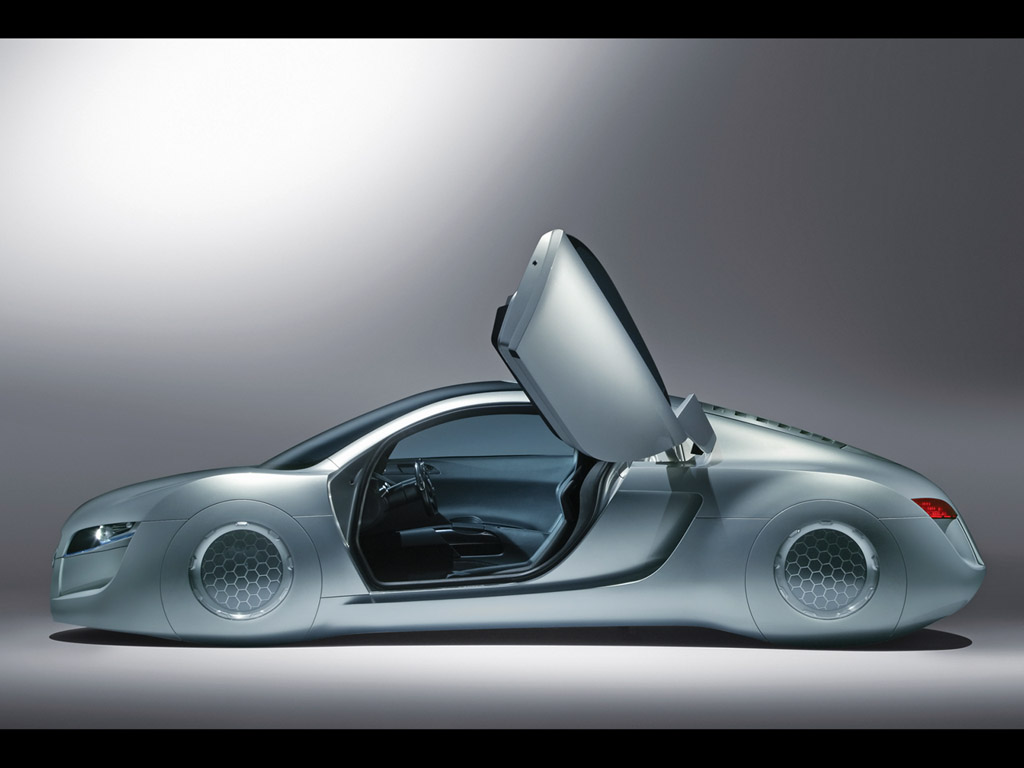
Audi RSQ
The resulting Audi RSQ sport coupe is a visionary interpretation of Audi’s typical design language. The most important thing was that despite its extreme character the car should still be recognized as an Audi. The cinemagoer will therefore see the new Audi front-end with the typical single-frame grille in the movie
The RSQ includes special features suggested by movie director Alex Proyas. The mid-engined sports car operated by the story’s police department, races through the Chicago of the future not on wheels but on spheres. Its two doors are rear-hinged to the C-posts of the body and open according to the butterfly principle
In addition to the RSQ concept car, Audi supplied further series-production cars which appear – in disguised shapes – in the movie s traffic scenes. Audi also supplied the interior mock-up used for interior car
scenesDesigners, engineers, technicians and model engineers had just ten weeks to build the concept car. At the beginning of July the Audi RSQ arrived on the set in Vancouver where it was to stay for several months of shooting. Audi also supplied an outer-skin model of the car to be used in a crash scene, as well as a separate interior mock-up to shoot interior scenes.
It is 2035 in Chicago, and cars no longer travel on wheels but on spheres. ”Integrating these spheres into the car’s design was one of the greatest challenges we had to solve”, says Julian Hanig, responsible for the RSQ’s exterior design. The result was a two-seat, mid-engined sports car with sphere-shaped wheels running in similarly shaped wheel arches. Hanig said. ”This even enhanced the car’s sculptured character.”
It is a sculpture that appears very flat, broad and bullish on the road. The laminate glass fiber body of the RSQ is coated with lunar silver paint, which creates the so-called flop effect. That is to say: when exposed to intensive light the bluish sheen of the silver paint takes on a golden tone.
The striking shape of the angular body cutouts for the head-light modules influence the front-end appearance of the RSQ. They are combined with side air inlets. The xenon light tubes behind the clear-glass covers enhance the character of the front-end design.
Where you find the rear window on most sports coupes, an aluminium hood covers the engine in the RSQ. In plain view this cover is an oval, running right up to the windscreen and integrated into the body by a transverse bar.
The gull-wing doors are another RSQ highlight: whenever Will Smith gets into or out of the car, the rear-hinged doors open upwards like a butterfly’s wings, and twist slightly at the same time
Tuesday, September 13, 2011
2011 Frankfurt: Audi Urban Concept【Video】
Audi has officially unveiled the Urban concept. This car is intended to show what the future of small and very fuel-efficient cars for city dwellers might look like.
The lithium-ion battery – weighing in at 90kg and counting for almost 20 per cent of the Urban Concept’s total weight – lives behind the seats and takes about an hour to charge for a range of 45 miles. It takes 16.9 seconds to get to 62mph.
The Audi Urban Concepts weight 480 kilograms (1,058.22 lb) thanks to the lightweight chassis design and the numerous CFRP components, and measure 3,219 millimeters (126.73 in) in length, 1,678 millimeters (66.06 in) width, and just 1,189 millimeters (46.81 in) height.
The 21-inch wheels are free-standing, their surrounding protective arches feature blinking strips of LED lights.
The aircraft-inspired cabin is minimalistic, but features a floating dashboard, aluminum pedals and a hexagonal steering wheel. Occupants sit side by side, but the passenger seat is moved back 30cm (11.81 in) to "provide sufficient shoulder and elbow room."


Press Release
The Audi urban concept
Audi is breaking new ground: The Audi urban concept technology study is a 1+1 vehicle for urban and metropolitan areas. The electric powered show car has four wheels, but does not fit into any current automobile category. Weighing just 480 kilograms (1,058.22 lb), the Audi urban concept combines elements of a racecar, a roadster, a fun car and a city car into a radical new concept. It has the potential to become the trendsetter for a new form of mobility.
Concept
"How much car is necessary to deliver driving pleasure and urban mobility in an entirely new way?" This question was the starting point for the Audi urban concept. A model of a sailplane was in the studio during the development process as an example of lightweight construction, efficiency and reduction - of the principle of "less is more."
The result is a vehicle that cannot be pigeonholed, a vehicle that redefines the term "driving pleasure" and is completely unencumbered by the baggage of conventional concepts. The Audi urban concept concentrates on the pure essence of driving and conveys freedom at the premium level. At the same time, it offers the comfort and safety of a closed automobile, making it far superior to any motor scooter. With its sleek body and free-standing wheels, the technology study is progressive and highly dramatic while at the same time extremely sporty, yet surprisingly comfortable.
The cabin of the Audi urban concept offers slightly offset seating for two. The roof slides back for entry. This innovative solution makes the Audi urban concept even more fun to drive because the canopy can remain open in good weather. It also allows the cabin to be aired out very quickly. The fit and finish of the show car is characterized by the obligatory Audi perfection. The car's technology is reflective of the brand's wide-ranging competence, particularly in ultra-lightweight construction.
The brand with the four rings has created an entirely new class of vehicle with the Audi urban concept, and that on the premium level. It also marks the new entry point to Audi's future range of electric vehicles, which is crowned by the R8 e-tron high-performance sports car. The Audi urban concept quite literally makes it easy to get into electric mobility.
The technology study is targeted toward people who are interested in technology and are enthusiastic about new approaches to mobility, independent of their age and status. In particular, it addresses an urban public whose lifestyle both reflects the car's modern concept and the driving pleasure associated with it and is a good fit for a possible innovative leasing system.
Exterior design
The Audi urban concept features an all-new design that still has certain historical roots in the Auto Union racecars of the 1930s. They were well ahead of their time conceptually: they were extremely lightweight and their engines were mounted in the rear. Their large, open wheels also stood out from the chassis - another parallel with the modern show car.
Painted in Electric White, pearl effect, today's technology study - 3,219 millimeters (126.73 in) long, 1,678 millimeters (66.06 in) wide, but just 1,189 millimeters (46.81 in) high - has a body on which all the lines are surging forward. The greenhouse is extremely flat. The roofline drops down like a wedge while the side window rises upward. The typical Audi tornado line gives the urban concept a strong shoulder.
An upright, forward-leaning blade in front of the rear wheel accentuates the side view. The Speed Red contour gives the appearance of a roll bar and evokes the Audi R8 high-performance sports car. The flanks of the body flare outward toward the bottom to enlarge the floor. This serves two purposes: It generates downforce at higher speeds and it can be used to charge the battery via induction - a particularly convenient method.
The characteristic Audi single-frame grill, which sports the four rings, appears as a closed surface on the Audi urban concept. It tilts forward to provide access to the charging socket. The narrow LED headlights project three-dimensionally from the body.
The turn signals are LED strips running along the fenders. These closely encircle the free-standing wheels, and the front fenders turn with the wheels when steering. The three-dimensional rear lights with the tail light and brake light are integrated into the vehicle body and wrap around the top of the rear window. At the back of the car is a small luggage compartment that pulls out like a drawer.
The front segment of the greenhouse is movable - another innovative idea that is unique to the Audi urban concept. Mounted on rails, it can be slid back by hand over the fixed rear segment.
It is up to the driver to decide whether to close the canopy or leave it open. The technology study is a roadster-on-demand that has neither roll-down windows nor a heavy air conditioner. When closed, the canopy provides protection against rain and cool air. Audi has also developed a second body variant as an alternative to the urban concept: a Spyder with a flat window strip wrapping around the cockpit and doors that open upward at an angle.
Interior
Entry to the Audi urban concept is via the slide-back canopy. The driver and passenger step over the edge of the vehicle as if they were stepping into the bathtub - there are no doors. This does not require any great flexibility; a handle on the windshield frame and special cutouts on the seating surfaces facilitate entry.
The show car offers room for two. The driver and passenger sit next to one another, with the right seat offset by 30 centimeters (11.81 in) to the rear to provide sufficient shoulder and elbow room. The seats are fixed, integral components of the monocoque, which provides for significant weight savings. They are covered with foam seating surfaces custom-fabricated to the measurements of the customer, just like in a racecar. The seat belts run through cutouts in the seat backs.
Sitting in the Audi urban concept is somewhat like sitting in an airplane cockpit. The seating position is very sporty. The driver can precisely adjust the positions of the aluminum pedals and the steering column. Both components are telescoping. The pedals can be moved a total of 22 centimeters (8.66 in), while the steering column can be moved 14 centimeters (5.51 in) for easier entry and additional 6 centimeters (2.36 in) for a custom driving position.
The steering column is exposed - a thick, elegantly designed section, open in the center and mounted virtually horizontally. At the far end of the steering column is a display for the most important information. The small, hexagonal steering wheel includes buttons and roller switches for controlling various systems, including selecting the Audi drive select modes for the electric drive system.
The entire interior of the technology study is subjugated to the strict dictates of ultra-lightweight construction. Running below the windshield across the entire cabin is a wing-shaped section that is also open in the middle. This new style of dashboard includes satellite controls for the heater and two large air vents.
Rather than carpeting, an innovative mat covers parts of the floor. This is made from a technical textile originally developed for athletic shoes that is water repellant and very durable. The seats are covered with cloth, with the edges of the foam pads framed in kangaroo leather. Aluminum applications accentuate the dashboard.
Technology
The Audi urban concept is also without peer with respect to the technical concept. The outer skin of the show car is made of carbon fiber-reinforced polymer (CFRP); the occupant cell is a mix of CFRP monocoque and an aluminum structure. This ultra-lightweight construction is the foundation for the technology study's extremely low curb weight of just 480 kilograms (1,058.22 lb).
The sophisticated chassis underscores the distinctively sporty personality of the Audi urban concept. Wishbones made from a combination of aluminum and CFRP locate the free-standing, 21-inch wheels.
Manufactured using cladding technology, the wheels are very light and feature a variant of the blade design from the Audi e-tron models. The tire sizes are as unusual as the car as a whole - 125/60 up front and 145/50 in the rear.
The Audi urban concept uses pushrod technology borrowed from motorsports. As in a racecar, the struts mounted in the interior of the monocoque are nearly horizontal. Four disc brakes provide the stopping power. The turning circle measures less than nine meters (29.53 ft) - ideal for a city car. Thanks to the vehicle's low weight, the rack-and-pinion steering does not require any power assistance. Crumple zones in the front and rear plus two airbags provide for a high degree of passive safety. An innovative assistance system helps the driver to avoid collisions with pedestrians.
The battery is mounted transversely behind the seats. The lithium-ion battery, which weighs around 90 kilograms (198.42 lb), stores 7.1 kWh of usable energy. The study's two electric motors together produce 15 kW (20 hp) of continuous power and 47 Nm (34.67 lb-ft) of torque. The motors are mounted between the rear wheels, which they drive via a single-speed transmission.
The Audi urban concept accelerates from 0 to 100 km/h (62.14 mph) in 16.9 seconds. It reaches 60 km/h (37.28 mph) in around six seconds. The show car steps off from traffic lights smartly thanks to the torque of the electric motors, which is fully available from standstill. Top speed is governed at 100 km/h (62.14 mph).
The action radius in the European driving cycle is 73 km (45.36 miles). The battery recharges completely in about 20 minutes with 400 volt three-phase current, and in approximately one hour with 230 volt household current.
Audi Wireless Charging
Audi is hard at work on the future of charging technology as an alternative to the charging at a power outlet. Audi Wireless Charging (AWC) refers to contactless induction charging. The infrastructure side, comprising a coil and an inverter (AC/AC converter), is placed on the normal parking spot of the Audi urban concept and connected to the power grid. The 3.6 kW primary coil set into the plate generates a high-frequency alternating field.
The charging process begins automatically when the urban concept drives onto the plate. The alternating magnetic field of the infrastructure side induces an alternating current across the air gap in the secondary coil, which is integrated into the vehicle. This current is rectified and fed into the vehicle's electrical system, where it charges the battery or powers consumers such as the heater. The alternating field is only generated if the vehicle is standing over the plate and thus poses no danger to people or animals.
Charging stops automatically when the battery is fully charged. The driver can interrupt charging at any time. The efficiency of AWC is comparable to that of other charging technologies. It is not affected by rain, snow or ice. The new technology makes charging electric vehicles easy and extremely convenient. A later version of the technology will be able to be integrated into the transportation infrastructure as a retrofit for parking garages or residential streets, for example.
Monday, September 12, 2011
Audi Sport Cars Concept A9 by Daniel Garcia
Developed on the lines of top-end luxury sports saloons, the “Audi A9” by Spanish designer Daniel Garcia is a luxury sports cars concept made using nanotechnology that includes an automatic system for repairing damage and color copacity adjustment. Featuring a wide windscreen that extends to complete the roof, the Audi Sport Cars Concept A9 by Daniel Garcia also touts the bodywork enhanced with a unique “electronic painting” system, allowing the owner to change its color at the touch of a button.
Audi Sport Cars Concept A9 by Daniel Garcia
Spanish designer Daniel Garcia has come up with the futuristic hybrid Audi A9 concept car. This amazing auto is equipped with a system that can automatically repair damage to the Audi Sport Cars Concept A9 by Daniel Garcia. The designer believes that futuristic Audi cars developed to accommodate four people need to incorporate options for the next-gen Audi developments, a variety of full-featured multimedia functions, special scratch-protective covering and either full electric or hybrid systems.

Audi Sport Cars Concept A9 by Daniel Garcia
The Audi Sport Cars Concept A9 by Daniel Garcia runs on an advanced hybrid setup with an internal combustion engine working in conjunction with four in-wheel electric motors, while the styling of the A9 concept was partially inspired by the stunning architectural style of Santiago Calatrava’s buildings in “La Ciudad de las Artes y de las Ciencias” (The City of Arts and Sciences) in Garcia’s hometown of Valencia. The bodywork of the Audi Sport Cars Concept A9 by Daniel Garcia concept also features a unique ‘electronic painting’ system which means the vehicle’s color can be changed at the touch of a button.

Audi Sport Cars Concept A9 by Daniel Garcia
Here Audi Sport Cars Concept A9 by Daniel Garcia with a sporty design, the Audi is rumored to work on the A9 in its reports note that the A9 range. Previous would be a four-door coupe that Mercedes-Benz CLS happen. But during a four-door model, the new cars in Auto Bild, the Audi Sport Cars Concept A9 by Daniel Garcia to come first as a two-door coupe and convertible.
Audi Sport Cars Concept A9 by Daniel Garcia
With a wide and low body that has passengers’ seats almost in a lying position, the Audi Sport Cars Concept A9 by Daniel Garcia delivers a remarkable high speed and insurmountable comfort at the same time. There won’t be any need to open the rear doors frequently, since the driver will not be having passengers that often in this sports car that rivals the Porsche Panamera. The designer has left many automobile enthusiasts to ask the category of people the car is meant for and what it actually does.


Audi Sport Cars Concept A9 by Daniel Garcia
Thursday, August 25, 2011
ABT Audi A6 Avant

Abt Sportline has just revealed a new tuning program for the Audi A6 Avant,includes a new aerodynamics package, plus a sensible power upgrade for all the model range's engines.
There will be several upgraded changes, especially around the exterior sides. There will be changes on the front spoiler, rear spoiler with custom model, side bars, rear apron that will flow smoothly into the exhaust pipes.
The 2012 Audi A6 Avant by ABT will be available with light wheels with optional sizes of 21, 20, or 19-inch along with high speed tiring features. For the exhaust system, there will be rear skirt model that also includes the end pipes.
Mechanically, the tuners from ABT have upgraded both versions of the 3.0-litre TDI model, and as a result the 245 HP (180 kW) variant produces 300 HP (221 kW) while the weaker version delivers 240 HP (177 kW) instead of 204 HP (180 kW).


Press Release
The "Estate of the Art" in sport - the new ABT AS6 Avant
Amazing what it can do: the ABT AS6 Avant is a fast luxury liner which likes going on long journeys. Both sporty and dynamic, it offers driving pleasure - its excellent comfort ensures that this pleasure remains even on long trips. And in the rear it impresses with large luggage space as well as the typical ABT view of four exhaust pipes. "This estate stands for lifestyle and power. Which is also going to be honoured by the driver behind you", Hans-Jürgen Abt clarifies. The CEO of the now 115 years old company adds: "The vehicle shows all of our experience in tuning."
The AS6 Avant is certainly self-confident, no question. But it also acts elegant and classy, and looks just as good outside the opera as well as at the car park of the Nürburgring. The fact that its home is originally on the race track is clear from the three swift letters: A-B-T. The performance data speaks the same language: the most powerful turbo diesel with three litre cubic capacity provides 300 HP/221 kW thanks to ABT POWER (series-standard: 245 HP/180 kW). The weaker version of the 3.0 TDI now provides 240 HP or 177 kW (series-standard: 204 HP/150 kW). The AS6 Avant provides the maximum sports combination with the performance-improved V6 gasoline engine: the Kempten engineers have conjured up a huge 420 HP (309 kW) from the basic version's sporty 300 HP. The versatile premium class fun estate, is also capable of a strong sprint: the ABT AS6 Avant sprints from 0 to 100 km/h in exactly five seconds.
Optically the estate looks decent and extravagant, and appears confident and powerful from all sides: the sidebars and front spoiler harmonise with the elongated contours of the vehicle. The crowning feature is the rear spoiler and the rear apron set with four exhaust pipes. The design of the ABT AS6 Avant also includes light-metal designer wheels, which are available in 19, 20 and powerful 21 inch sizes. It goes without saying that ABT also offers alloys in combination with high-speed tyres which suit the car's performance potential.
Whatever engine the customer chooses - he/she always gets a balanced vehicle which meets the highest demands: everyday reliability and suitability for long journeys in combination with maximum sportiness characterise the new ABT AS6 Avant. After all you don't want to go without comfort and luxury just because you are in a particular hurry.
The new ABT AS6 Avant - data and facts
ABT ENGINE TECHNOLOGY
Engine: 3.0 TDI, 2967 ccm capacity
Performance tuning: ABT POWER
Performance: 240 PS/177 kW (standard: 204 PS/150 kW)
ABT ENGINE TECHNOLOGY
Engine: 3.0 TDI, 2967 ccm capacity
Performance tuning: ABT POWER S
Performance: 300 PS/221 kW (standard: 245 PS/180 kW
ABT ENGINE TECHNOLOGY
Engine: 3.0 TFSI, 2995 ccm capacity
Performance tuning: ABT POWER
Performance: 420 PS/309 kW (standard: 300 PS/221 kW)
ABT AERODYNAMICS
ABT side skirts
ABT front spoiler
ABT rear skirt insert and 4-end pipes
ABT rear spoiler
ABT WHEEL TECHNOLOGY
ABT sport rims in 19 to 21 inch
Available also as complete set of wheels with sports tyres
Sunday, August 21, 2011
Audi R8 TDI Le Mans Concept
The V12 TDI is closely related to the engine in the Audi R10, the two-time Le Mans winner - so it catapults the Audi R8 into supercar terrain concerning performance too. It sprints from zero to 100 km/h (62.14 mph) in just 4.2 seconds and its top speed is well over 300 km/h (186.41 mph). The peak torque, reached at only 1,750 rpm, paves the way for effortless acceleration that is unrivaled even at this level.
The new V12 TDI belongs to Audi's family of V engines but has the ideal included angle for this engine type of 60 degrees between cylinder banks. Its highlights include the new chain drive layout that includes the two newly developed high-pressure pumps for the common rail injection system.
Its sound is as thrilling as you'd expect in a sports car of this caliber. For all the subtle smoothness that typifies this design principle, the twelve-cylinder unit is full-bodied and equipped with energetic overtones that make no secret of its performance potential.
Thanks to their high performance and pulling power, all Audi TDI engines are ultra-dynamic sources of power. The brand has often enough demonstrated its sporty character in its production cars, especially the six- and eight-cylinder 3.0 TDI and 4.2 TDI. Audi has also been writing a new chapter in its success story on the racetrack since 2006. The diesel engine in the R10 sports prototype won its very first endurance race at Sebring, Florida, when it was pitted against an entire field of gasoline-engined challengers. But its most crucial victories were surely in 2006 and 2007 in the 24 Hours of Le Mans, when it simply outclassed the
international elite.
The V12 TDI race engine in the R10 produces over 650 hp from a displacement of 5.5 liters, giving it the potential for a top speed as high as 330 km/h (205.05 mph) depending on the gear ratios. Its power and sturdiness immediately impressed both fans and experts, who were impressed by its restrained noise level. Unusual for a race engine, this powerful Audi diesel makes barely more than a whisper.
Long traditions of motor racing and production technology complement each other at Audi. The FSI engine of the R10's predecessor, the R8, captured five wins at Le Mans with a direct gasoline injection system. Audi is also looking to maximize the advantage by using the race-tested FSI principle in its production models. The latest examples of this are the V8 with high-revving concept in the RS 4 and the production version of the Audi R8.
Audi R8 TDI Le Mans Concept
The V12 TDI is closely related to the engine in the Audi R10, the two-time Le Mans winner - so it catapults the Audi R8 into supercar terrain concerning performance too. It sprints from zero to 100 km/h (62.14 mph) in just 4.2 seconds and its top speed is well over 300 km/h (186.41 mph). The peak torque, reached at only 1,750 rpm, paves the way for effortless acceleration that is unrivaled even at this level.
The new V12 TDI belongs to Audi's family of V engines but has the ideal included angle for this engine type of 60 degrees between cylinder banks. Its highlights include the new chain drive layout that includes the two newly developed high-pressure pumps for the common rail injection system.
Its sound is as thrilling as you'd expect in a sports car of this caliber. For all the subtle smoothness that typifies this design principle, the twelve-cylinder unit is full-bodied and equipped with energetic overtones that make no secret of its performance potential.
Thanks to their high performance and pulling power, all Audi TDI engines are ultra-dynamic sources of power. The brand has often enough demonstrated its sporty character in its production cars, especially the six- and eight-cylinder 3.0 TDI and 4.2 TDI. Audi has also been writing a new chapter in its success story on the racetrack since 2006. The diesel engine in the R10 sports prototype won its very first endurance race at Sebring, Florida, when it was pitted against an entire field of gasoline-engined challengers. But its most crucial victories were surely in 2006 and 2007 in the 24 Hours of Le Mans, when it simply outclassed the
international elite.
The V12 TDI race engine in the R10 produces over 650 hp from a displacement of 5.5 liters, giving it the potential for a top speed as high as 330 km/h (205.05 mph) depending on the gear ratios. Its power and sturdiness immediately impressed both fans and experts, who were impressed by its restrained noise level. Unusual for a race engine, this powerful Audi diesel makes barely more than a whisper.
Long traditions of motor racing and production technology complement each other at Audi. The FSI engine of the R10's predecessor, the R8, captured five wins at Le Mans with a direct gasoline injection system. Audi is also looking to maximize the advantage by using the race-tested FSI principle in its production models. The latest examples of this are the V8 with high-revving concept in the RS 4 and the production version of the Audi R8.
Subscribe to:
Posts (Atom)